
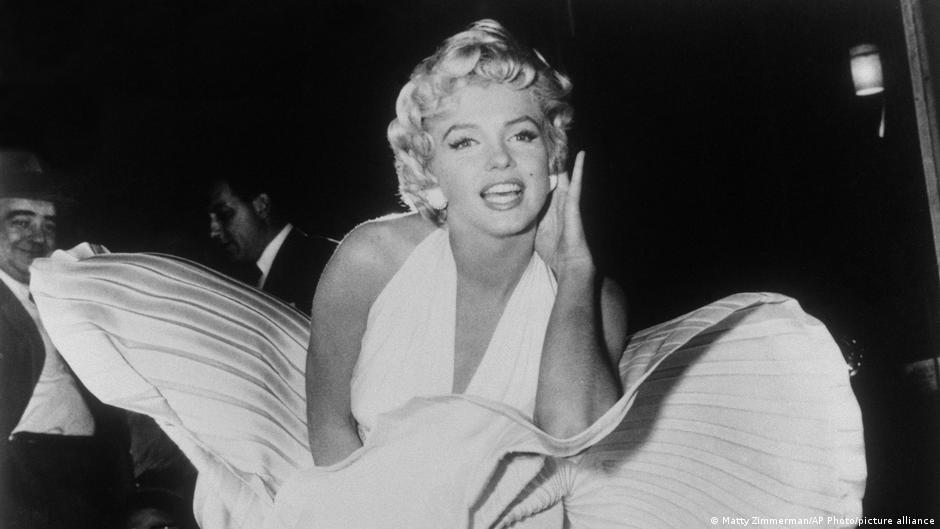
Marilyn Monroe's Legacy Reimagined 100 Years After Her Birth
A century after her birth, Marilyn Monroe's legacy is being re-evaluated, moving beyond her iconic status as a 1950s sex symbol to recognize her as an early advocate for women's self-determination in Hollywood.
This reinterpretation highlights her efforts to navigate and challenge a male-dominated film industry, offering a more nuanced understanding of her impact.
Born Norma Jeane Mortenson on June 1, 1926, in Los Angeles, Monroe's early life was marked by instability, including foster homes and orphanages.
She began her career as a model before being discovered by film studios, eventually adopting the stage name "Marilyn Monroe." Hollywood quickly molded her into the archetype of the seductive blonde, a role that brought her global stardom through films like "Gentlemen Prefer Blondes," "The Seven Year Itch," and "Some Like It Hot."
## Beyond the Glamour: Monroe's Intellectual Pursuits
Despite being confined to stereotypical roles by studios, Monroe actively pursued intellectual growth.
She dedicated herself to acting training and showed a deep interest in literature, politics, art, and psychoanalysis.
Photographer Eve Arnold captured a notable moment in 1955, showing Monroe engrossed in James Joyce's "Ulysses," a book she reportedly kept in her car and read aloud for its language, despite its complexity.
This aspect of her life often contradicted the public's perception, which she noted often preferred to reduce her to a character rather than acknowledge her true self.
## Challenging the Studio System
Monroe's actions are increasingly viewed through a feminist lens, recognizing her as someone who challenged the entertainment industry's mechanisms long before many others.
She understood how her image was marketed and strategically used it to advance her career, attempting to leverage the system's restrictions to her advantage rather than being merely a victim.
A significant step in this direction was her decision to found her own production company in late 1954.
This move was highly unusual for an actress at the time and demonstrated her desire for greater control over her roles, better contracts, and more substantive material.
She was known for negotiating higher salaries and publicly contradicting producers, refusing roles she disliked—a remarkable display of self-confidence in an era when studios largely controlled their stars.
However, Monroe also faced the contradictions of her time.
While her femininity and erotic appeal were celebrated, these same qualities were later used against her, with media often portraying her as unstable or unprofessional.
Her private life, including marriages to Joe DiMaggio and Arthur Miller, along with her psychological struggles, became public spectacles.
Her death in 1962, officially ruled a likely suicide, quickly led to myth-making and persistent conspiracy theories.
## A New Perspective in the #MeToo Era
Recent years have seen a significant shift in perceptions of Monroe, partly influenced by the #MeToo movement and broader discussions about power dynamics in Hollywood.
This has led to a greater recognition of the pressures she faced within a studio system that simultaneously idealized and controlled women.
The 2022 biopic "Blonde," starring Ana de Armas, explored this perspective, portraying Monroe as a vulnerable and traumatized figure.
While some saw it as a critical examination of Hollywood's treatment of women, others felt it perpetuated a narrative of victimhood.
Monroe's enduring global recognition, a century after her birth, underscores her profound influence on modern pop culture.
Her story highlights the complexities of female self-determination in a world that both admires and seeks to control women, making her a compelling figure for contemporary discussions on gender and power.
Key points
- Marilyn Monroe, born Norma Jeane Mortenson on June 1, 1926, is now seen as an early advocate for women in Hollywood, beyond her image as a sex symbol.
- Monroe founded her own production company in late 1954, an unusual move for an actress at the time, to gain more control over her roles and contracts.
- Perceptions of Monroe have shifted in recent years, with discussions around the #MeToo movement reframing her story within the context of the studio system.